
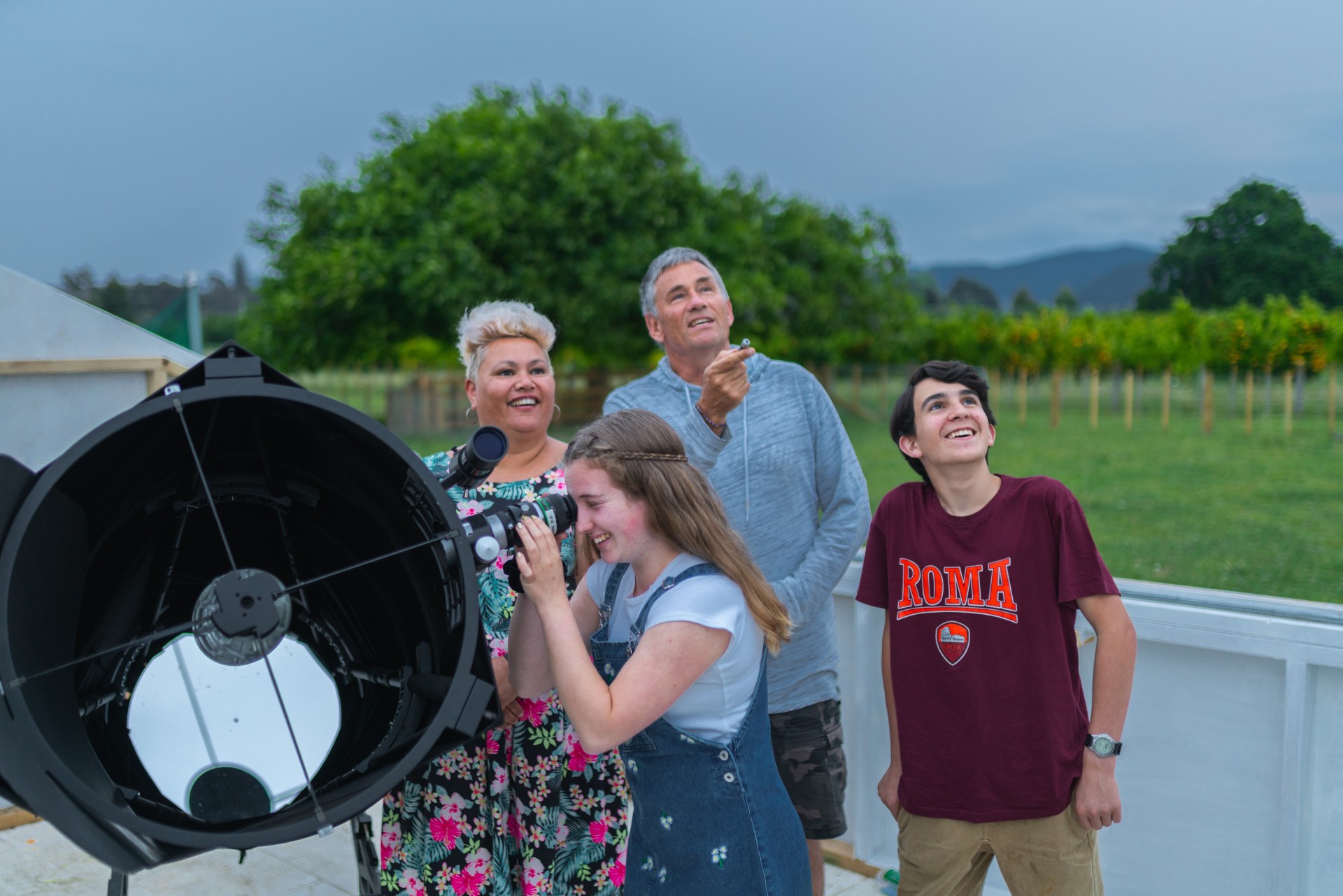
When the sun sets, another spectacle begins.
In a region famous for being the first to see the sun, there's another claim hiding in plain sight - Tairāwhiti is also the first to see the stars. With clear skies, low light polution, and a rare southern vantage of the Milky Way galaxy and beyond, East Coast is a dream for stargazers and astronomy lovers alike.
Based just outside Gisborne, John Drummond has quietly become one of Aotearoa New Zealand's most celebrated astronomy educations. His work has contributed to the discovery of over 20 exoplanets, a free-floating black hole, and as asteroid named after his observatory - and late wife - "Possum".
John runs Gisborne Astro Tours, an intimate, family-friendly experience where guests can gaze through high-powered telescopes, photograph the moon with a smartphone, and hear stories that make the science, well... less sciency. He makes the cosmos feel close - and his tour is one of the region's most surprising highlights. Travellers have been known to visit Tairāwhiti just to experience his tour and see our night skies.
10 things you didn't know about stargazing in Gisborne
- You can see the centre of the galaxy above your head. The heart of the Milky Way passes directly overhead in winter - a celestial spectacle invisible to most of the world.
- Some stars here can't be seen from the Northern Hemisphere. The Southern Cross, Alpha Centauri, and the Magellanic Clouds are all uniquely visible from Tairāwhiti.
- You're only 15 minutes from darkness. From the city to the dark sky in under a quarter of an hour, Patutahi, the coast, or any dark road will do. To be fair, you can still see the Milky Way from an urban Gizzy backyard!
- Rocket Lab launches light up the night. Catch a glimpse of an electron rocket curving skyward from the Māhia Peninsula, Titirangi Kaiti Hill, or anywhere you can see toward Māhia.
- Saturn's rings are real - and unforgettable. Through a telescope, they draw gasps every time. So do the lines and the moons of Jupiter.
- Bring your phone - and leave with a moon crater photo. John encourages guests to capture close-ups through his telescope.
- It's an all-ages experience. Kids, grandparents, first-timers - everyone leave a little more star-struck.
- Summer brings Orion. Winter brings everything else. For the clearest skies and the brightest galaxy views, winter is prime time.
- In Tairāwhiti, the stars aren't just for science - they're ancestors, storytellers, and guides. Look up, you're looking into whakapapa.
- Visitors often say the same thing: "I've never seen starts like this." Even New Zealanders from the cities are blown away by how many stars are visible.
Where to look up: Stargazing spots
- Titirangi Kati Hill - easy access, big horizons
- Māhia Peninsula - Rocket Lab adjacent, skies like nowhere else
- Up the Coast (Anaura, Tokomaru) - remote and stunning
- Anywhere in Tairāwhiti really, stop scrollng, toggle off and look upward!
"The higher and darker, the better," says John. "Find a hill, a beach, or just a quiet patch of country and let your eyes adjust."
Gisborne's space connection
Rocket Lab's nearby launch site brings a uniquely modern twist to the region's night sky appeal. Locals often spot launches streaking upwards, sometimes even mistaking them for meteors! From Rocket Lab to the Rings of Saturn, night skies in Tairāwhiti are a local treasure - and this quiet corner of Aotearoa reaches further than most imagine.
Pro tip: Sign up for Rocket Lab's email newsletter and follow them on Facebook to stay updated on upcoming Māhia launches (LC-1). Bring binoculars and tune into their YouTube channel during the launch window for a live broadcast with close-up views and expert commentary. There's about a 20-second delay, but pairing the livestream with the real-time sky show is something special. Headphones recommended.
Note: Launch windows often shift due to weather or technical tweaks - delays, postponements, and event last-minute scrubs are all part of the game. Be patient, be flexible, and dress for the conditions.
